Survivor Leadership at UNGA 2026 and the Work to End Modern Slavery.

Survivor Leader, Founder of Empowerment Collective, and Member of the Global Commission on Modern Slavery and Human Trafficking
During United Nations General Assembly High-Level Week in New York, I joined leaders from global policy, government, philanthropy, business, law, and civil society for two important conversations about preventing abuse, combating human trafficking, and building systems that truly support survivors.
I left these conversations with gratitude for everyone who brought their knowledge, commitment, and humanity to the room. I also left with a message I believe must guide our collective work: survivor leadership belongs wherever solutions are designed, decisions are made, and resources are allocated.
Survival becomes knowledge. Knowledge becomes leadership. Leadership becomes a solution.
Ahead of Harm and the importance of prevention
I was honored to open Ahead of Harm: Reimagining How We Prevent Abuse and Support Survivors, co-hosted by EverFree and Thomson Reuters. The conversation brought together leaders to consider how we can stop abuse before it happens and create systems that respond to the needs of people who have experienced it.
My sincere thanks to Heather Panton and the teams at Thomson Reuters and EverFree for creating this space and welcoming survivor knowledge into the conversation.
Thank you to Ilias Chatzis of the United Nations Office on Drugs and Crime (UNODC), Dr. Kari Johnstone of the Organization for Security and Co-operation in Europe (OSCE), and Katherine “Kat” Chon of the U.S. Department of Health and Human Services (HHS). Their session considered the global, regional, and national landscapes of prevention and survivor support.
Thank you also to Amy Hutsell of Georgia’s Criminal Justice Coordinating Council (CJCC), Nicole “Nikki” Clifton of The UPS Foundation, and Heather Lively of Wellspring Living. Their discussion explored what integrated systems look like on the ground, with a particular focus on Georgia as a model.
These conversations matter because prevention must begin before exploitation becomes someone’s lived reality. It must reach children, families, workers, and communities while meaningful choices and protections are still available to them.
Aligning for Action through partnerships
On September 23, 2026, I also took part in Aligning for Action: Transformative Partnerships to Combat Human Trafficking, co-hosted by the McCain Institute, Justice & Care, Hogan Lovells Cadwalader, and the Global Commission on Modern Slavery and Human Trafficking.
I am grateful to Ambassador Cindy Dyer, Chief Program Officer at the McCain Institute; Amy O’Neill Richard, its Senior Director for Human Rights and Freedom; and Jessica Roberts of Justice & Care for their contributions to this gathering and to the work of strengthening protection and justice.
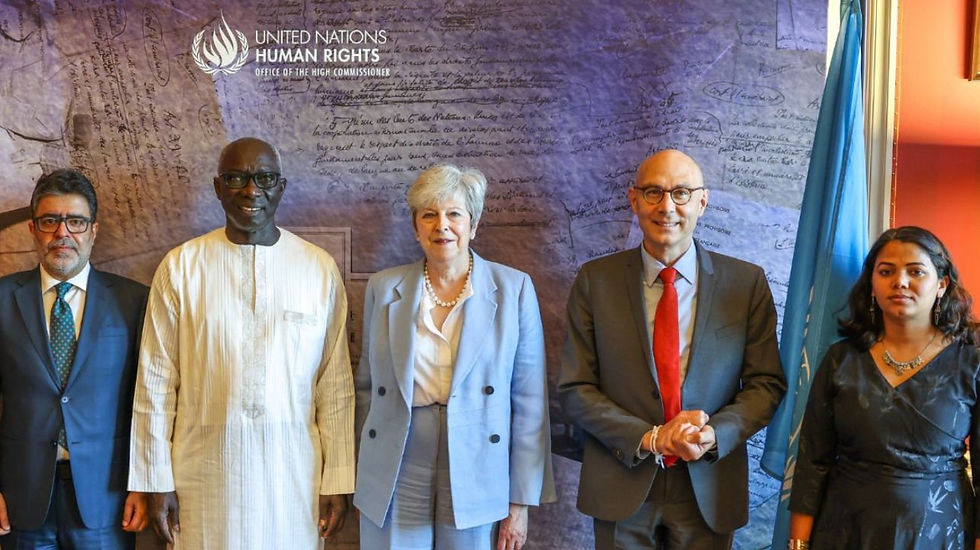
My heartfelt thanks to Baroness Theresa May, Chair of the Global Commission on Modern Slavery and Human Trafficking, for her leadership and for inviting me to serve as a Commissioner. I was already practicing survivor leadership through my organizations, Empowerment Collective and Global Women’s Handicrafts. Joining the Commission brought that knowledge into a wider international conversation.
During the reception, the images of humanitarian photographer Lisa Kristine reminded us of the power of storytelling to bring these realities into view. Thank you, Lisa, for the humanity and dignity your work brings to this issue.
The gathering brought lived experience together with legal expertise, policy leadership, survivor-informed practice, and private-sector engagement. No single organization, sector, or solution can tackle human trafficking alone. We need partnerships that strengthen prevention, prosecution, and protection, with survivors helping lead the work.
What survival teaches us about systems
Many people already know parts of my story: surviving child labor in the textile industry, escaping forced marriage, witnessing human rights atrocities against women, and seeing how undocumented people can become vulnerable to trafficking and exploitation by labor recruiters.
I did not come to these conversations only to tell that story again. I came to help lead a way back to the root of the problem, to reach the people who are still trapped.
What I lived through and survived was not only trauma. It became knowledge about where systems fail. When I was a child in the sweatshop, I did not know the words “modern slavery,” “human trafficking,” or “supply chains.” I knew what it felt like from the inside: the heat, hunger, anxiety, stress, and exhaustion.
Modern slavery is not simply a country issue, a religious issue, a corporate issue, or an issue that belongs only to the anti-trafficking community. It is a universal human issue.
The global estimates published in 2022 by the International Labour Organization, Walk Free, and the International Organization for Migration estimated that 50 million people were living in modern slavery in 2021, including forced labor and forced marriage. Women and children remain disproportionately vulnerable.
Behind that number are human beings. Survivors can identify failures that may be difficult to see from outside a system. We understand what happens before and during exploitation, what it can take to escape, and what happens afterward. Survivor-led initiatives bring that knowledge to the design of programs, so human needs are not reduced to incomplete data.
Survivor leadership means genuine authority
Survivors do not replace academics, governments, businesses, law enforcement, or civil society. These sectors are essential partners. Survivors contain a living body of knowledge that should stand beside those sectors of knowledge as an equal.
Survivor leadership means survivors are present where legislation is drafted, where prosecutors and law enforcement are trained, where corporate supply-chain policies are written, and where funding is allocated. We must be there with genuine authority.
When survivors help design solutions and programs, those efforts are more likely to address what people actually need. When survivors evaluate programs, we can help distinguish between what looks successful on paper and what truly creates safety, empowerment, and generational healing.
What was beautiful about the Commission was seeing people from different countries, cultures, languages, and experiences—government, law, business, corporate responsibility, civil society, and survivors—sitting together as equals.
We can no longer design solutions for people without designing them with the people who have lived the problem. That is the transformation survivor leadership represents.
Nepal and the connection between disaster and exploitation
The devastating Bhotekoshi–Trishuli flood disaster in Nepal on August 26, 2026, brought the urgency of this work close to home. It also raised a question that extends beyond any one disaster: how do we protect people from exploitation when they have lost the foundations of their lives?
Preliminary research by the Asian Institute of Technology points to a massive rock-ice avalanche and landslide as the disaster’s primary trigger. The researchers also identify long-term warming and changes in glacier and permafrost conditions as possible contributors to slope instability.
For me, the broader lesson is that disaster response and trafficking prevention must be connected. When people lose homes, income, infrastructure, and community support, they can become more vulnerable to deceptive recruitment, unsafe migration, forced labor, and trafficking.
Emergency relief is essential. Rebuilding also requires sustained, person-to-person support that understands a community’s relationships, cultures, traditions, and livelihoods. Through Empowerment Collective, this is the approach I work to build: support that protects dignity and strengthens a community’s ability to shape its own future.
People who live inside the consequences of a system possess knowledge about its failures. I believe the exploitation of people and the exploitation of nature must be addressed together. Our responses to the climate crisis, displacement, and modern slavery must include the leadership of the communities living through their consequences.
No Country Is Immune and the responsibility to act
In April 2025, the Global Commission launched No Country Is Immune at United Nations Headquarters in New York. That title carries a message we cannot ignore: modern slavery reaches across borders, and our response must do the same.
The Commission’s work addresses stronger legislation, responsibility in business and supply chains, and prevention in the context of crises. Poverty, conflict, displacement, unsafe migration, and the climate crisis must be considered alongside the economic systems that can put profit before people.
More than twenty-five years after the adoption of the Palermo Protocol in 2000, we must ask whether our systems are keeping up with the realities victims and survivors are living today.
Modern slavery can occur on construction sites, in care work, nail bars, farms, factories, fishing vessels, mines, and private homes. The risks can also be present in the supply chains behind the clothes we wear, the phones we depend on, and the food, tea, coffee, and chocolate we consume.
I believe technology and artificial intelligence present both extraordinary opportunities and serious dangers. If we build the technologies of the future on the unconscious consumption of the past, we risk reproducing the same exploitation and invisibility. Human dignity and accountability must shape the systems we build.
Gratitude and the work ahead
Thank you to EverFree, Thomson Reuters, Heather Panton, Ilias Chatzis, Dr. Kari Johnstone, Katherine “Kat” Chon, Amy Hutsell, Nicole “Nikki” Clifton, and Heather Lively for the conversation on prevention and survivor support.
Thank you to Baroness Theresa May, the Global Commission on Modern Slavery and Human Trafficking, the McCain Institute, Ambassador Cindy Dyer, Amy O’Neill Richard, Justice & Care, Jessica Roberts, Hogan Lovells Cadwalader, and Lisa Kristine for helping bring these different strengths together.
Thank you also to the organizing teams, staff, participants, and everyone whose work behind the scenes made these gatherings possible.
My most important message is this: we are in a transformation in how we understand survivor leadership. The knowledge of people who have lived inside the failure of systems must stand beside institutional knowledge with equal dignity and genuine influence.
Survivors who escaped the darkness have carried their voices and testimony into the light so others could see what was happening. They are torchbearers, helping lead the way back to those who are still trapped.
Every step we take together should honor that knowledge and make room for that leadership. That is how we move from conversation to collective action.
Learn more about Empowerment Collective, explore Global Women’s Handicrafts, and join me in the call to End Modern Slavery Now. For speaking engagements and collaborations, visit NasreenSheikh.com.


Comments